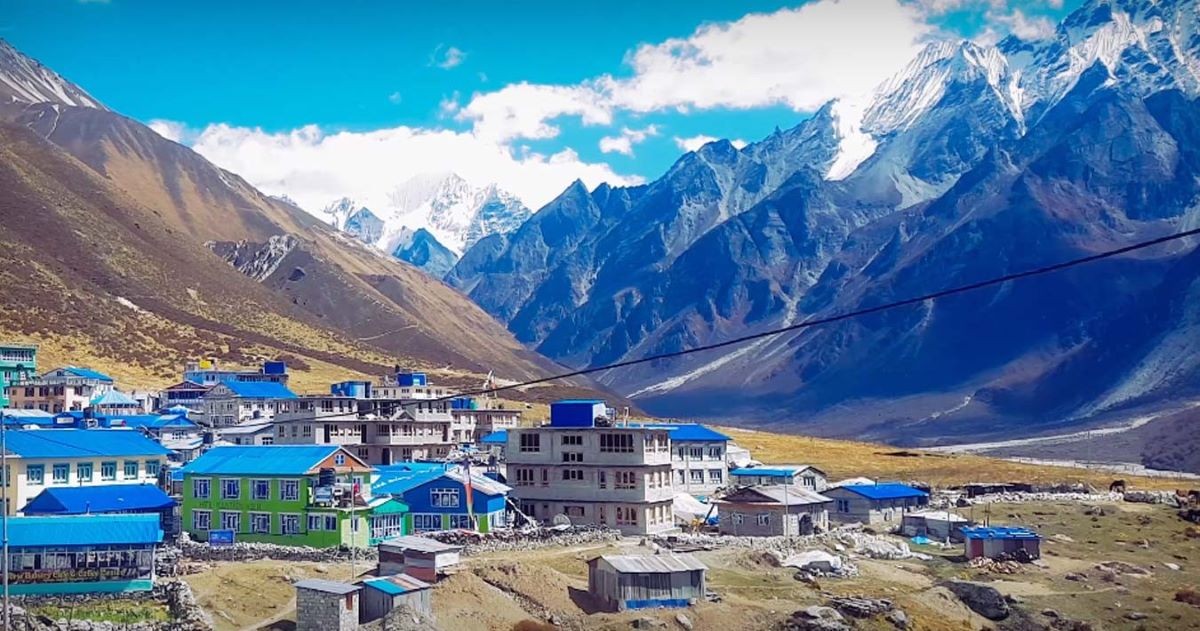
Langtang Helicopter tour, the closest reachable Himalaya from Kathmandu is the shortest helicopter tour to explore the Himalayas and isolated glacial valley, high country flora and fauna as well as Tibetan culture. Helicopter tour starts from Kathmandu directly heads towards north to Langtang Himalaya. It is about an hour very exciting round trip flight of Langtang with close view of wonderful landscapes, vegetation, magical Himalaya panorama and hidden valley. Langtang National Park valley is famous for its unique curved U shape valley with the longest glacier of Nepal, numerous glacial valleys, hanging icefalls, dozens of trekking peaks, ice lands, waterfalls, lush green ravines, moraines, red panda, Himalaya black beer, wild boar, snow leopard, Himalayan pheasants, rare species of medicinal plants, yak grazing pasture lands, yak cheese factory and Tibetan culture.
This tour package is the combination of thrilling Himalayan experience by helicopter tour and wildlife safari in Chitwan National Park and medieval era temple tour in Kathmandu valley.
Day 01: Arrive Katmandu, explore Kathmandu valley
Arrive Kathmandu. Transfer to hotel, have lunch then visit Kathmandu Durbar Square and Kalimati Agro-market. Dinner and overnight.
Kathmandu Durbar Square
In the heart of the old city: the Durbar, that is "the square of the royal court", where it seems to go back in time. In the Durbar square, there are more than fifty temples and monuments and among these stands, the magnificent Temple of Taleju, which houses the deity of the royal family and which is possible to visit only externally. Its three roofs are covered with gilded copper and a series of jingling bells makes the atmosphere even more magical. It was built by King Mahendra Malla between 1549 and 1596 and dedicated to the Goddess Taleju Bhawani. The Kasthamandap, whose name means "wooden house", was built in the 12th century and it was King Laxmi Nar Singh Malla who wanted its construction with the wood of a single "sal" tree. Initially ceremonies were held in the building and it was the meeting place of the foreigners who participated in it and only later was it dedicated to Gorakhnath but due to 2015 earthquake, some of the monuments including this are totally collapsed. Tiny temple of Ashok Binayak with no spire is also known as Maru Ganesh, a deity much loved by the Nepalese, the elephant-headed god. Returning further to the square is the Temple of Shiva. Still in the square, the old Royal Palace, the Hanuman Dhoka (the monkey god) who was built in the 17th century by King Pratap Malla, although over the years they have been made several improvements and additions. Near the square, the Kumari Temple palace, a monastic building built in the mid-18th century and a masterpiece of Newari art, with richly carved wooden windows. Here lives the living goddess, or Kumari, incarnation of Taleju Bhawani, the protective goddess of the royal family, manifestation of Goddess Durga.
Kalimati Agro-Market
Kalimati fruit and vegetable wholesale market where we see interesting activities of selling and buying all kinds of fruits, fresh and dry vegetables, lentil grains, fresh and dry fishes. The market seems active almost 24 hours but more active early in the morning. During the day, big trucks are not allowed to enter the main city area so they drop the stuff at night. All dealers and shopkeepers gather there early morning to distribute the items to the market within 6-7am. During day time, they segregate the leftover items and sell it and cleans their place. It may be worth visit the place to experience the lifestyle in local agro-market.
Day 02: Langtang Himalaya and hidden glacial valley tour by helicopter then explore Kathmandu valley
The day is dedicated to explore Langtang valley by helicopter then we visit Changunarayan, Bhaktapur and Patan in Kathmandu valley. After having breakfast, transfer to airport. We will have exciting lifetime experience helicopter tour in the Nepal’s longest glacial valley with magical eye catching view of Ganesh Himal (7407m), Langtang Lirung Himal (7246m), Dorje Lakpa Himal (6975m), Gosainkunda sacred lakes, hanging icefalls, lush green forests of Langtang National Park, beautiful settlements in the hill slopes, farmlands, traditional Tamang villages, Trishuli river valley and Kyanjin Gompa. It takes us very close to the serene Himalaya and flies close to the ground. So, the flight is famous for wonderful lifetime experience as well as for photography, filming, aerial photography, topography mapping etc.
Kyanjin Gompa (3950m)
Kyanjin Gompa is the ultimate destination of the trekking in the Langtang Himalaya region. Guests get off here for about half hour to enjoy the unique Himalayan nature and classic Tibetan culture. Dozens of sky soaring majestic Himalayan peaks and glacial valleys are just in front of you. You visit yak cheese factory, ancient monastery and Tibetan cultured people there. You may have tea/coffee and can enjoy with snow there. It’s better to stop for 15-20 minutes, longer stop may lead to altitude problem.
Changunarayan
As per the recorded history in stone sculpture, Changunarayan is the oldest and most traditional temples of Nepal built up in early 5th century. The temple of Lord Vishnu is in a beautiful ridgeline just 4km north of Bhaktapur Durbar Square. There are many interesting ancient temples, statues, stone sculptures, broken pieces of artistic rock statues, shelters, beautiful traditional Newari houses with artistic household items, handicrafts shops, a museum and restaurants in and around the temple complex. We see beautiful view of Kathmandu valley all around and the magical Himalaya panorama to the north.
Bhaktapur
15km to the east of Kathmandu, the city of Bhaktapur, also called Bhadgaon, the "city of devotees", is the ancient capital of one of the kingdoms of the valley. Here, one can really breathe the air of the past, because unlike Kathmandu, vehicles cannot circulate in the old city that is covered, therefore only on foot, and most of the buildings are wonderful examples of Newari architecture. It is certainly one of the most interesting places in Nepal, where it seems to return to the medieval era. It appears to have been founded in the 9th century by the legendary King Ananda Dev Malla and was the capital of the valley from the 14th to the 16th century. There are so many monuments like temples, palaces, culture history museum, buildings, water spouts, holy ponds, big bells, clay pottery and artistic stuffs in and around Bhaktapur Durbar Square, Dattatraya Square, Taumdhi Square and Pottery square. Similarly one can observe and experience typical lifestyle of local inhabitants Jyapu Newars working in and around.
Patan
5km southeast of Kathmandu, Patan is known as the finest city of temples and palaces. It played an important role over the centuries, even when the valley was divided into many feudal kingdoms. In 1372 it was conquered by a king of the Malla dynasty named Jayasthiti who, after ten years, unified the valley bringing the capital to Bhaktapur. During the reign of the Malla, the beautiful temples and palaces were built. There are so many beautiful monuments like Krishna Temple, Bhimsen temple, royal palaces, Patan museum, several temples in the Patan Durbar Square, water fountains, Patan’s oldest and valley’s one of the two tallest temples Kumbheshwar Shiva Temple built in 1392 (spire damaged by 2015 earthquake), Golden Temple (Hiranya Varna Mahavihar) etc.
Day 03: Kathmandu - Chitwan / 165km, approx. 5 hour drive
After having breakfast, drive to Chitwan. This is the scenic drive along Trishuli River valley, arrive Chitwan around noon. Check in hotel, have lunch then go to Chitaunia Tharu tribal village by bullock cart or own vehicle, visit their village, museum and observe their culture program. Back to hotel. We watch video on wildlife and safety techniques to be followed while we are travelling in the jungle. Dinner & overnight.
Chitaunia Tharu village culture
Rapidly increasing numbers of hotels, restaurants and settlements of the outsiders, there are very few numbers of typical houses of Tharu people with their traditional culture. Tharu museum is built up in the society and few houses nearby the museum are seen. Tharu culture program is performed in the evening in a particular house. Tharu women with black blouse, white lehenga skirt and silver ornaments perform some dances related to their regular lifestyle, men perform some exciting dances like peacock dance and mugra dance -stick dance etc.
Day 04: Explore Chitwan National Park
Have breakfast, go for canoeing where you enjoy canoeing safari with watching beautiful birds (like kingfisher, wall creepers, wagtails, love birds), crocodiles and occasionally one horned rhinos. You will have to follow the suggestion of local nature guide experienced in surrounding nature and environment. Then go for jeep safari in Chitwan National Park where one horned rhinos, herds of swamp and spotted deer, red macaque, black faced white money called common langoor, wild boar, peacocks and occasionally wild elephant and rarely Bengal tigers. Have pack lunch carried from the hotel. Visit elephant and crocodile breeding center, back to hotel. Dinner & overnight.
Chitwan National Park
Bounded by Parsa Wild Life Reserve in the east, Narayani River in the west, Rapti River in the north and settlements and India border in the south, Nepal’s 1st national park with an area of 932 sq. km. Chitwan National Park is enlisted in UNESCO natural heritage site. It’s located in 175km southwest of Kathmandu in subtropical zone with about 5-6 hour drive along Trishuli River which is famous for rafting. 544 species of birds, 68 species of mammals, 126 species of fish and 56 species of plants are found there.The national park is famous for one horned rhinos and Gharial crocodiles. There are lots of touristic activities like elephant ride, jeep safari, jungle walk, village tour by ox cart, bird watching, canoeing, boating, fishing, elephant polo, elephant race, ox race, Bishajari Tal (lake) tour, Tharu culture program etc.
Day 05: Chitwan - Kathmandu / Visit Swoyambhunath Stupa,
Swoyambhunath stupa
Swoyambhunath stupa located atop a hill west of the capital and the rising of this temple is of fundamental importance for the inhabitants of Nepal. Legend has it that many years ago, when the Kathmandu valley was a Tethyan lake, here was a beautiful lotus flower which had a blue beam of light. That flower was a god, a manifestation of Swoyambhu (the land created itself at the middle of the Tethyan ocean), the the original, primordial, Adi Buddha. Manjusri, which wanted to smell the flowers, to approach with his sword cut off the waters of the lake thus making the birth of the Kathmandu Valley. Manjusri then built the temple Swoyambunath of just where the lotus flower was shining, he founded the city of Kathmandu and then returned to China. Drive back to hotel. Dinner and overnight.
Day 6: Explore Kathmandu valley
Visit Pashupatinath and Bouddhanath in the morning. Have farewell Nepali lunch at Bhim’s house in Raniban. Free afternoon for relax and shopping, drive back to hotel. Dinner & overnight.
Pashpatinath
Pashupatinath is the most important Hindu temple in the country, dedicated to one of the manifestations of Lord Shiva and is a shepherd of animals, men and a symbol of fertility. The temple stands on the bank of the Bagmati river (born from the mouth of Shiva), where cremations take place. In the complex there is the Golden Temple, one of the most sacred temples of Nepal, whose access is allowed only to Hindus. Around the temple premises, there are hundreds of shrines built up in different dates from 5th century to the present.
Bouddhanath Stupa: Here is the largest Tibetan community in Nepal, of which motions, have come here following the invasion of their country by China. The origin of this stupa is still unknown although it appears to have been built in the sixth century, at the time of the Tibetan king Srongsten Gompa, who had converted to Buddhism after marrying two wives, one Chinese and one Nepalese ‘Bhrikuti Tara’, both of Buddhist faith. It is the majestic largest stupa in Nepal. It was collapsed in 2015 earthquake but it’s rapidly rebuilt within 2 years in its original shape and size. Around the great stupa, many monasteries and shops have sprung up and every day dozens of faithful walk around its perimeter in a clockwise direction. The large white cap is often streaked with yellow / orange: it is the saffron powder thrown by the faithful as an act of devotion in honor of Buddha.
Day 7: Fly back home
Have breakfast, check out hotel, and transfer to airport
Tour cost per person (US$)
2pax group: $3499
3pax group: $2999
4pax group: $2599
5pax group: $2499
10pax group: $2499
11pax group: $2399
It includes:
Langtang National Park permit, trip permit and wildlife safari in Chitwan National Park, helicopter landing permit, monument sites and area entry permits for the entire trip, food (3 meals a day: breakfast, lunch and dinner), accommodation, English speaking guide (can manage other language guide if required) and surface and air transportation including private charter helicopter as per the itinerary.
It excludes:
Nepal Visa, guests’ travel insurance, any kind of gift and donation, gratuity to the serving staff, cold drinks and alcoholic beverage, emergency evacuation, cost of personal nature and the cost not mentioned in includes section.
Type of Helicopters used for the tour:
Airbus French helicopter - Ecureuil AS350B series ….
Lifetime memorable exciting scenic photogenic helicopter tour in the Langtang valley surrounded by majestic serene Himalayas, traditional villages and typical lifestyle of Tamang and Sherpa tribes, medieval era monument sites in Kathmandu, Chitaunia Tharu tribal culture tour and wildlife safari in Chitwan National Park.


Destination
Activity
Start/End Point
Duration
Grade
Season
Group Size
Hotel/Accomdation
Highest Elevation